BAIN MUSC 726T
Tuning Theory
Intervals
Web apps: Bain, Ratio to Cents;
Matthew Yacavone, Xen-calc
See also: Mathematical
Terms & Concepts
Types of Numbers
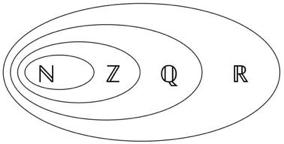
In mathematics, the natural numbers (ℕ) are the
set of whole numbers:
1,
2,
3,
4, 5,
…
The
ellipsis symbol (...), meaning 'and so on'. In this case, it
indicates that the number sequence continues indefinitely.
The integers (ℤ) are the set of positive and negative
whole numbers plus 0:
…, –3, –2, –1,
0, 1,
2, 3, …
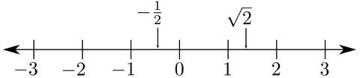
Geometrically, the integers are often
visualized as discrete points on an integer number line.
Given two integers
p and
q, the
rational
numbers (ℚ) are the set of all numbers that may be
expressed as the quotient:
p/
q,
where
q ≠
0. An
irrational number is a number
that cannot be expressed as the quotient
p/q; e.g.,
√2.
The
real numbers (
ℝ
) are the set of rational and irrational numbers, which
are usually represented by a
decimal expansion;
e.g.,
–1/2 = –0.5, and
√2 =
1.414.... As shown below, the real numbers form
a continuous set of numbers that may be represented as
quantities on the number line.
For more information, see the Wikipedia article
Lists
of types of numbers.
String Length and Pitch Interval
If we divide a string of length L whose fundamental
frequency is f into parts such as
1/2 L, 1/3
L, 1/4 L, 1/5 L, ...,
plucking those parts
of the string will sound the following frequencies,
respectively:
2/1
f, 3/1 f,
4/1 f, 5/1 f, ...
Comparing the quotients 1/2
& 2/1,
1/3 &
3/1, 1/4 & 4/1, 1/5 &
5/1, ... we notice they
are multiplicative inverses of one another. In mathematics, the multiplicative
inverse, or reciprocal, of q/r
is defined to be r/q;
i.e., q/r * r/q
= 1. The reciprocal of x is defined to be 1/x.
For example, the reciprocal of 1/2
may be calculated:
1 / (1/2) = 1
* (2/1) = 2/1
For more information, see the Wikipedia article multiplicative
inverse.
The Law of Pythagoras
In physics, Mersenne's first law states: if the tension
and linear
mass density of a stretched string are constant, the
fundamental frequency
(f) of the string is inversely proportional to its length (L)
which may be written:
The English physicist
James Jeans
(1877-1946) called this relationship the
Law of Pythagoras
(
Jeans 1968). For more information
about the relationship between string length and frequency, see
the Wikipedia article
Mersenne's
Laws.
* * *
Pitch interval
In music, an
interval is the distance between two
pitches, which we will describe as a
ratio between two
frequencies.
For more information, see the Xenharmonic Wiki article
interval.
Ratio
In mathematics, a
ratio expresses the relationship between
two or more quantities; e.g., the ratio between the frequencies
880 Hz and 440 Hz is 2:1. All ratios may be expressed as
fractions; e.g. 2/1.
For more information, see the Wikipedia article
ratio.
Fraction
A
fraction describes the number of parts in a whole. The
top
number in a fraction is called the
numerator (
n),
and the bottom number is called the
denominator (
d).
A fraction is typically represented as the quotient
q =
n/
d,
where
n and
d are integers. Non-integer values for
n and
d are also possible.
For more information, see the Wikipedia article
fraction.
String-length divisions
If we divide a string of length
L into parts as shown
below,
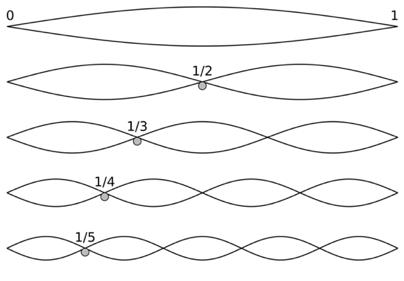
Credit:
Wikipedia
we
can abstractly represent the integer string-length
divisions using fractions as shown below; e.g.,
1/2 L +
1/2 L
=
L1/3 L +
2/3 L
=
L
1/4 L + 3/4 L
=
L
1/5 L +
4/5 L
=
L
etc.
In physics and music, the integer divisions of
the string are called
harmonics. These are the
nodes
of the string.
For more information see the following articles in Wikipedia:
standing
wave,
node,
harmonic
series, and
harmonic.
Simplest form
In mathematics, fractions are usually reduced to their
simplest
form, or reduced form.
Examples: 880/440 may be
reduced to 2/1,
660/440 to
3/2, 550/440 to 5/4, 600/500
to 6/5, 4/2 to 2/1,
6/4 to 3/2, 12/9
to 4/3, etc.
For more
information, see the Wikipedia article Simplifying
(reducing) fractions, or the Wolfram MathWorld article Reduced
fraction.
Decimal
expansion
A fraction (n/d) may
also be represented as a decimal expansion where we
divide the fraction's numerator (n) by its denominator (d).
Examples: 2/1 = 2.0, 3/2 = 1.5, 4/3 = 1.333..., 5/4 =
1.25, etc.
For more
information, see the Wolfram MathWorld article Decimal
expansion.
Unity (1:1)
In tuning theory, the ratio 1:1 serves as a point of
reference. For example, it may represent the unison
interval or the fundamental of a harmonic series. Most often, it
is used to represent the tonic degree in a scale, and
the other degrees in the scale are expressed as a frequency ratio
in relation to the prime unity 1:1 (Partch
1947).
For more
information, see the Xenharmonic Wiki articles unison and scale, respectively.
Octave
reduction
In tuning theory, pitches and intervals are usually
expressed as ratios within the 1/1 to 2/1 octave; i.e., as
fractions under simplification and octave reduction.
Examples.
The frequency ratios 1/1, 2/1, 3/1, 4/1
& 5/1 are equivalent to
the following ratios under octave reduction, respectively: 1/1,
2/1, 3/2,
2/1 &
5/4
For more information, see the Xenharmonic Wiki
article octave
reduction.
Complementary
intervals
The octave complement of an interval is the difference
between that interval and an octave. For example, using simple
algebra, the octave complements of 3/2, 5/4, and 9/8,
respectively are calculated:
(3/2) * x
= 2/1;
x = (2/1) * (2/3) = 4/3
(5/4)
* x = 2/1; x = (2/1)
* (4/5) = 8/5
(9/8) * x = 2/1;
x = (2/1) * (8/9) = 16/9
Superparticular ratios
Superparticular ratios are ratios of the form
(
x+1)/
x, where
x is a positive
integer. Such ratios correspond to intervals formed by adjacent
members of the harmonic series.
Examples.
Superparticular ratios include:
2/1,
3/2, 4/3, 5/4, 6/5, 7/6, 8/7, 9/8, 10/9, etc.
For more information, see the Wikipedia article
Superparticular
ratio.
Pythagorean means
In mathematics, the three classical
Pythagorean means
are the
arithmetic
mean,
geometric
mean, and
harmonic
mean. According to the medieval theorist
Boethius (c.
480-524), the ancient Greek mathematician
Archytus
(4th c. BCE) proved that a superparticular ratio cannot be
divided into two equal rational parts by a geometric mean. That
is, superparticular intervals are inherently indivisible into
two equal rational parts. So the ancient Greeks declared the
arithmetic mean and harmonic mean to be harmonious ways to fill
in the gaps in a musical scale.
For more information, see the Wikipedia article
Pythagorean
means.
Interval System Models
- The Harmonic Series {WP; XW}
- as a sequence of string lengths:
- 1/1, 1/2, 1/3, 1/4, 1/5, 1/6, 1/7,
1/8, 1/9, 1/10, ...
- as a sequence of pitches:
- 1/1, 2/1, 3/1, 4/1, 5/1, 6/1, 7/1,
8/1, 9/1, 10/1, ...
- as a sequence of pitches under octave reduction
- 1/1, 2/1, 3/2, 2/1, 5/4, 3/2, 7/4,
2/1, 9/8, 5/4, ...
- as one axis of the Lambdoma (Hero and
Foulkrod 1999)
- The Tetractys {WP}
1, 2, 3, 4
- 1/1 {XW} – Perfect
unison (PU)
- 2/1 {XW} –
Perfect octave (P8)
- 3/2 {XW} – Perfect
fifth (P5)
- 4/3 {XW} – Perfect
fourth(P4)
- The 6:8:9:12 framework, or nexus
(1/1, 4/3, 3/2, 2/1) = (6/6, 8/6, 9/6,
12/6) = 6:8:9:12
- See: Pythagorean hammers {WP}
- Pythagorean (3-limit)
tuning {WP;
XW}
Pitch formula: 2p
* 3q, where p
and q are integers
Diatonic scale: 1/1, 9/8, 81/64,
4/3, 3/2, 27/16, 243/128, 2/1
- 1: 1/1
- 2: 9/8 {XW} –
Pythagorean major second
- 3: 81/64 {XW}
– Pythagorean major third
- 4: 4/3
- 5: 3/2
- 6: 27/16 {XW}
– Pythagorean major sixth
- 7: 243/128: {XW}
– Pythagorean major seventh
- 8: 2/1
- Other intervals in the system:
- 16/9 {XW} –
Pythagorean minor seventh
(4/3) * (4/3) = 16/9
- 32/27 {XW} –
Pythagorean minor third
(4/3) / (9/8) (4/3) * (8/9) =
32/27
- 128/81 {XW} –
Pythagorean minor sixth
(2/1) / (81/64) = (2/1) * (64/81) =
128/81
- 256/243 {XW} –
Pythagorean diatonic semitone
(4/3) / (81/64) = (4/3) * (64/81) =
256/243
- 2187/2048 {XW} –
Pythagorean chromatic semitone, or apotome; e.g., F3–C4–G4–D5–A5–E6–B6–F#7
(3/2)^7 / (2/1)^4 =
(2187/128) / 16 = 2187/2048
- Chromatic scale:
- 1/1, 256/243, 9/8, 32/27, 81/64, 4/3, 729/512, 3/2,
128/81, 27/16, 16/9, 243/128, 2/1 (Gann
2019, p. 57)
- Just (5-limit) tuning
{WP;
XW}
Pitch
formula: 2p * 3q
* 5r, where p, q,
and r are integers
Diatonic scale: 1/1, 9/8, 5/4, 4/3, 3/2, 5/3, 15/8, 2/1
- 1: 1/1
- 2: 9/8 – Large whole tone
- 3: 5/4 M3 {XW} – Just major third
- 4: 4/3 P4
- 5: 3/2 P5
- 6: 5/3 M6 {XW} – Just major sixth
- 7: 15/8 M7 {XW} – Just major
seventh
- 8: 2/1 P8
- Other intervals in the system:
- 6/5 {XW} – Just
minor third
(3/2) / (5/4) = (3/2) * (4/5) = 6/5
- 8/5 {XW} – Just
minor sixth
(2/1) / (5/4) = (2/1) * (4/5) = 8/5
- 9/5 {XW} – Just
minor seventh
(18/8) / (5/4) = (9/4) * 4/5 =
9/5
- 10/9 {XW} – Small
whole tone
(5/4) / (9/8) = (5/4) * (8/9) = 10/9
- 16/15: {XW} –
Just diatonic semitone
(4/3) / (5/4) = (4/3) * (4/5) = 16/15
- 25/24 {XW} – Just
chromatic semitone
(5/4) / (6/5) = (5/4) * (5/6) = 25/24
- 45/32: {XW} –
Just diatonic tritone
(9/8) * (5/4) = 45/32
- Chromatic scale:
- 1/1, 16/15, 9/8, 6/5, 5/4, 4/3, 45/32, 3/2, 8/5, 5/3, 9/5,
15/8, 2/1 (Gann 2019, p. 57)
Twelve-tone equal temperament (12-tet)
In twelve-tone equal temperament (abbr. 12-tet;
see also 12edo, or 12ed2) {WP;
XW}, the 2/1 octave is
divided into 12 equal-sized intervals called semitones.
The size of each semitone is equal to the twelfth
root of two:
21/12
≈
1.059
As such, the
chromatic scale may be represented as fractional powers of 2;
i.e.,
20/12,
21/12, 22/12, 23/12, 24/12,
25/12, 26/12, 27/12, 28/12,
29/12, 210/12, 211/12, 212/12
Simplifying the
fractional exponents we get:
1/1, 21/12,
21/6, 21/4, 21/3, 25/12,
21/2, 27/12, 22/3, 23/4,
25/6,
211/12, 2/1
Equivalently, we may use
decimal expansions:
1.0, 1.059, 1.122, 1.189, 1.260, 1.335,
1.414, 1.498, 1.587, 1.682, 1.782, 1.889, 2.0
Finally, we can also use EDO-step notation (n\n-EDO),
where n is the nth step in n-EDO:
0\12, 1\12, 2\12, 3\12, 4\12, 5\12,
6\12, 7\12, 8\12, 9\12, 10\12,
11\12, 12\12
EDO is an abbreviation for
equal division
of the octave. For more information, see the Xenharmonic
Wiki article
EDO. For
some other important EDOs, see Marc Sabat's article
Introduction
to EDO tunings on the Ableton website.
Cents
The cent
is a logarithmic
unit of pitch interval proposed by the nineteenth-century English
mathematician A.J.
Ellis (1814-90). By definition, there are 1200 cents in a
2/1 octave and 100 cents in a 12-tet
semitone. To compare the size of two interval frequency ratios, we
will typically convert ratios to cents
(¢). The following formula will convert an interval
frequency ratio (f1/f2)
to cents (c):
c = 1200 log2 (f1/f2)
For example, rounding to
the nearest cent the ratio 3/2 is equivalent to 702¢, or more precisely:
1200 log2 (3/2) ≈
701.995¢
The following mobile Web app will perform this calculation.
Calculator: Bain, Ratio to Cents
It rounding all cent
values to 3 decimal places, or nearest 1/1000 cent. Here is the
12-tet chromatic scale using cents, with the diatonic scale
degrees highlighted using bold type:
0, 100, 200,
300, 400, 500, 600, 700, 800, 900,
1000, 1100, 1200
For a multi-purpose
interval calculator/converter that can play any interval, see
Matthew Yacavone's Xen-calc.
For other interval size units, see the Xenharmonic Wiki article Interval size
measure.
Commas
A comma
is a small difference that arises when a note is tuned in
different ways. Here are some of the commas we will encounter in
our study of tuning theory. For more information, see the
Xenharmonic Wiki article comma.
- Pythagorean comma (PC) {WP;
XW}
- Difference between 12 just perfect fifths and seven octaves
(3/2)^12 / (2/1)^7 = 531441/524288 ≈
23.5¢
- Also:
- 1.5^12 / 2^7 ≈
129.746/128 ≈ 1.014
- Syntonic comma (SC) {WP; XW}
- Difference between the Pythagorean major third (81/64) and just major third (5/4)
(81/64) / (5/4) = (81/64) * (4/5) =
81/80 ≈ 21.5¢
Other small differentials {WP}
(Gann 2019, pp. 35-36)
- Diesis {WP; XW}
- Difference between the octave and three just major thirds
(2/1) / (5/4)^3 = (128/64) / (125/64)
= (128/64) x (64/125) = 128/125 ≈ 41.1¢
- Schisma (PC/SC) {WP; XW}
- Difference between the Pythagorean comma and syntonic
comma
(531441/524288) / (81/80) =
32805/32768 ≈ 1.95¢
- Septimal comma {WP;
XW}
- Difference between the Pythagorean minor seventh and just
minor seventh
(16/9) / (7/4) = (16/9) * (4/7) =
64/63 ≈ 27.3¢
- Limma {WP}
- Kleisma {WP; XW}
EDO intervals
- Semitone = 100¢
- 1/4 tone
= 200/4 =
50¢
- 1/5 tone = 200/5 ≈ 40¢
- 1/6 tone = 200/6 ≈ 33¢
etc.
In n-EDO, the step size is 2^1/n. For example,
the step size in 31edo is:
2^1/31 ≈ 1.02261144 ≈ 38.71¢
For more information, see the Xenharmonic Wiki article EDO.
Interval Names
The following interval galleries
will be helpful when we are learning historical tunings and
temperaments:
- Kyle Gann, Anatomy of an Octave – A list of over 1000
intervals within the octave {Gann 2019} (Gann 2019)
- Manuel Op de Coul, Scala: List of intervals {HFF}
(See also: Scala)
- Wikipedia, List of pitch intervals {WP}
- Xenharmonic Wiki
- Gallery of Just Intervals {XW}
- List of Superparticular Intervals {XW}
- List of Overtones {XW}
The Web app Xen-calc can play any interval frequency
ratio:
Matthew Yacavone, Xen-calc
Links
Huygens-Fokker
Foundation: Centre for Microtonal Music {HFF} –
https://mathworld.wolfram.com
Wikipedia {WP} –
https://www.wikipedia.org
Wolfram MathWorld {MathWorld} –
https://mathworld.wolfram.com
Xenharmonic Wiki {XW} – https://en.xen.wiki
References
See: BAIN
MUSC 726T Bibliography
Duffin, Ross W. 2006. "Just
Intonation in Renaissance Theory and Practice." Music Theory
Online 12/3. {MTO}
Jeans, James. 1968/1937. Science
& Music. Mineola, NY: Dover. {GB}
Gann, Kyle. 2019. The
Arithmetic of Listening: Tuning Theory and History for the
Impractical Musician. Urbana: University of Illinois Press. {GB}
Hero, Barbara and R. M.
Foulkrod, 1999. "The Lambdoma matrix and harmonic intervals." IEEE
Engineering in Medicine and Biology Magazine 18/2
(March-April 1999): 61–73. {Lambdoma.com}
Partch, Harry. 1974/1949. Genesis
of a Music, 2nd ed. New York: Da Capo Press. {GB}
Rossing, Thomas, F.
Richard Moore and Paul Wheeler. 2002. The Science of Sound, Third Edition. New
York: Addison Wesley. {GB}
Updated: May 3, 2026



.svg)
#/media/File:Harmonic_partials_on_strings.svg)