Software
The Harmonic Series: A Path to Just Intervals, Consonance/Dissonance, Tuning Systems, and TimbreDOWNLOAD SLAPI 3
The original version of this website was created in the late 1990s to serve as an ancillary resource for the music theory and computer music courses I teach at the University of South Carolina – all of which touch upon the harmonic series (Bain 1998 and Bain 2001). In 2026, I updated the text for compatibility with Kyle Gann's The Arithmetic of Listening (Gann 2019), the textbook for my Tuning Theory class, and the software for compatibility with HTML5 and responsive mobile web design development.
Current version: 2.0.0
Release date: 5/15/2026
System Requirements: A modern web browser
Used in the following course: MUSC 726T Tuning Theory
References: Bain 1998, Bain 2002, Gann 2019
.png)
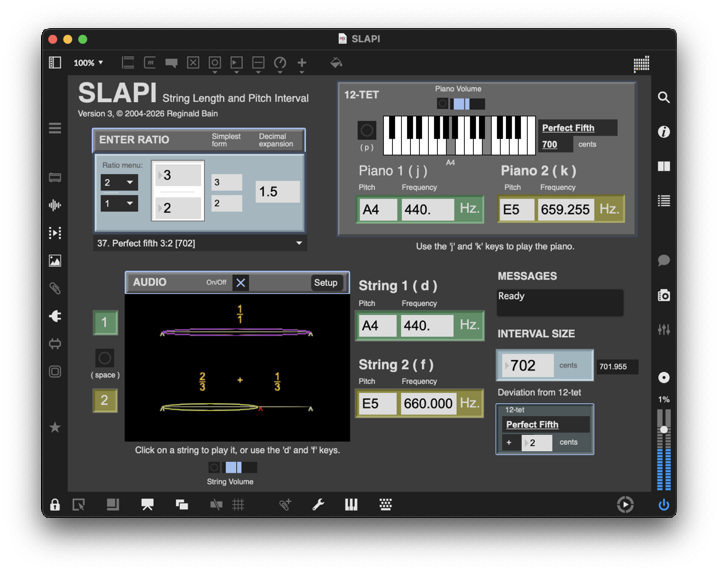
SLAPI – A harmonic series interval player
SLAPI (String Length and Pitch Interval) is a playground for hands-on experimentation with harmonic series intervals. It is a tool that allows the curiosity-driven learner to discover exactly how far "out of tune" equal-tempered intervals are with respect to nature. SLAPI makes it easy to easily explore the sonic signatures of just intervals on a plucked-string timbre and compare them with their equal-tempered counterparts on the modern piano. Enter whole-number ratio and SLAPI will report the ratio's simplest form, decimal expansion, size in cents, and deviation from 12-tet in cents. SLAPI will also visualize the ratio on a virtual monochord, reporting the associated pitch interval's component pitches and frequencies with respect to the standard pitch A4 = 440 Hz.
Created with Cycling '74's Max, SLAPI is currently being distributed as a Max patcher that runs under Max 9. Originally created with Cycling '74's Max 4 (Bain 2006), Version 3 sports a new dark-themed interface and interval-name compatibility with Kyle Gann's The Arithmetic of Listening (Gann 2019).
Current version: 3.0.0
Release date: 3/26/2026
QuickStart Doc: pdf
System Requirements: SLAPI is a Max patcher that currently runs under Max 9. For system requirements, see Cycling '74's Max 9 System Requirements page.
Used in the following course: MUSC 726T Tuning Theory
References: Bain 2006, Gann 2019
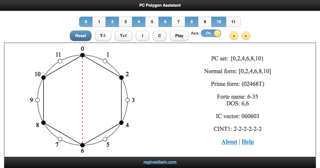
PC Polygon Assistant: Displays the polygon notation for a pitch-class set
PC Polygon Assistant will display the polygon notation for any pc set in the pitch-class universe. It will report the normal form of the set and the basic structural properties its set class including the: prime form, interval-class vector, Forte name, degree of symmetry (DOS), and CINT1. Students may also explore geometric analogies for transposition (T), inversion (I), and the complement relation (C) in pc space.
PC Polygon Assistant is a touch-optimized Web app that was designed to run on Apple's iPad or a desktop computer. The graphics are rendered using SVG. Playback utilizes Web Audio API. For more information, see my ATMI 2016 presentation (Bain 2012).
Current version: 2.0.3
Released: 2/14/22
System Requirements: A modern web browserQuickStart Doc: pdf
Used in the following courses: MUSC 525 Post-Tonal Theory; MUSC 726G Geometrical Music Theory
References: Bain 2016, Straus 2016; Also Rahn 1980, Morris 1987, Tymoczko 2011 and Toussaint 2013
Ratio to Cents 2.0.4
Twelve-Tone Assistant 2.4
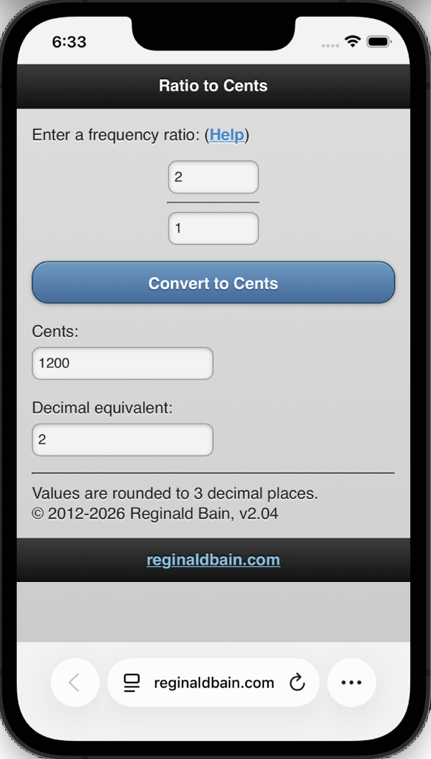
Ratio to Cents: Converts an interval frequency ratio to cents
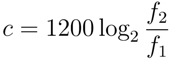
Ratio to Cents is a simple mobile phone Web app that converts an interval frequency ratio to cents. The program utilizes the conversion formula:
where c is cents, and f2 /f1 is a pitch interval expressed as a frequency ratio. Enter a frequency ratio (e.g., 1/1, 2/1, 3/2, 4/3, 5/3, 5/4, 6/5, 9/8, 7/4, 81/64, 22/7, 81/80, 128/125, 550/440, 531441/524288, etc.) and the program reports the ratio's size in cents and decimal equivalent. Ratios greater than 1/1 (upward pitch intervals) return a positive value. Ratios less than 1/1 (downward intervals) eturn a negative value. In addition to whole-number ratios, decimal values (e.g., 1.059/1, 1.618/1, 1.49535/1, 3.14/2, etc.) may also be entered. All values are rounded to 3 decimal places. For more information, see my ATMI 2012 presentation (Bain 2012).
Ratio to Cents was built with jQuery Mobile to run on Apple's iPhone and other mobile devices.
Current version: 2.0.4Released: 4/8/26
System Requirements: A modern web browser
QuickStart Doc: pdf
Used in the following course: MUSC 726T Tuning Theory
Reference: Bain 2012, Gann 2019
Twelve-Tone Assistant: A twelve-tone theory calculator and matrix maker
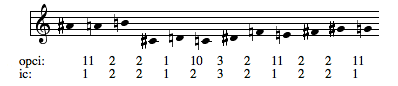
Twelve-Tone Assistant is a JavaScript application that performs basic 12-tone row operations (P, I, R, and RI) and generates matrices useful in the composition and analysis of twelve-tone music (Bain 2000). Enter a 12-tone row and the program can report: the row's 48 forms under P, R, I, and RI; its interval succession; and the set class membership of its discrete trichords, tetrachords, and hexachords. It can also determine if the row is: hexachordally combinatorial, all combinatorial, or an all-interval row. Available matrices include a standard 12 x 12 matrix (Babbitt Square), P-form array, I-form array, Permutational array, Babbitt Trichordal Array, and Stravinskyan four-part array and rotational array.
Current version: 2.4.0
Released: 2/24/2017
System Requirements: A modern web browser
Used in the following course: MUSC 525 Post-Tonal Theory
Reference: Bain 2000, Straus 2016
References
Bain, Reginald. 2016. "Scripting Web Apps for Music
Theory using SVG & Web Audio API." Association
for Technology in Music Instruction National
Conference (ATMI 2016), paper presentation. Santa
Fe, NM.
Bain, Reginald. 2012. "iPad Web App Development for
Music Theory." Association for Technology in Music
Instruction National Conference (ATMI 2012). San
Diego, CA.
Bain, Reginald. 2006. "The AIMS Project: Creative
Aspects of Musical Sonification." Proceedings of the
International Computer Music Conference (ICMC
2006), New Orleans, LA: 657-660.
Bain, Reginald. 2000. "Creating Web-based Applications
for Post-Tonal Theory." Musical Intersections 2000
international conference, paper presentation. Toronto,
Canada.
Bain, Reginald. 1998. "A Computer-Assisted Approach to Musical Acoustics." Association for Technology in Music Instruction National Conference (ATMI 1998), paper presentation. Fajardo, Puerto Rico.
Gann, Kyle. 2019. The Arithmetic of Listening: Tuning Theory and History for the Impractical Musician. Urbana, IL: University of Illinois Press.
Morris, Robert. 1987. Composition with Pitch Classes. New Haven: Yale University Press.
Nicholson, Thomas and Marc Sabat. 2018. Fundamental
Principles of Just Intonation and Microtonal
Composition. Available online at: <https://masa.plainsound.org/pdfs/JI.pdf>.
Rahn, John. 1980. Basic Atonal Theory. New York: Longman.
Straus, Joseph N. 2016. Introduction to Post-Tonal Theory, 4th ed. New York: Norton.
Toussaint, Godfried T. 2013. The Geometry of Musical Rhythm: What Makes a "Good" Rhythm Good?, 1st ed. Boca Raton, FL: CRC Press.
Tymoczko, Dmitri. 2011. A Geometry of Music: Harmony and Counterpoint in the Extended Common Practice. New York: Oxford University Press.