
Home | Bio | Music | Software | Teaching
Notes
for fixed media
by Reginald Bain
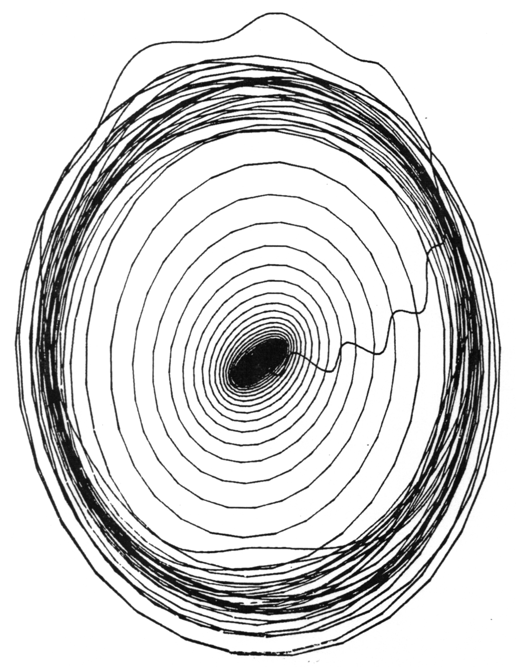
Retreat from Quiescence (1986, rev. 2013) is a musical realization of the Schrödinger equation from quantum mechanics. Using values for the probabilities at discrete energy levels, the Schrödinger wave equation was calculated and then transformed from the given interval for the "particle in a box" problem to the complex plane. The piece was composed in "chunks," each chunk corresponding to one set of energy levels and probabilities that were used in the summation of the wave function. Thus, each musical gesture corresponds to one "picture" of the state equation graphed in the complex plane. Each chunk was reviewed by the composer, and if useful, the probability of the duration selection was scaled to control articulation. The pitch space and timbre space are representations of the angular displacement and absolute value, respectively, of the mapping with respect to a predetermined central origin. Struck and plucked timbres represent the wave's discrete nature, whereas bowed and evolving timbres represent the wave's continuous nature. To create the work, the composer wrote a custom program using the C-programming language that generated MIDI events which could be interpreted by eled, an early MIDI event-list editor by Decker and Kendall (1985). The MIDI output was the realized via FM synthesis (Chowning 1973) on a rack-mounted set of eight Yamaha DX-7s called a Yamaha TX816 synthesizer.
| D U R A T I O N: | 5:27 |
The work was created on a Pyramid 90x minicomputer at the Northwestern Computer Music Studio in 1986. Originally for 4-track magnetic tape, this work was digitally remastered as part of my Music, Physics and Sonification project, a seed grant from the University of South Carolina's Creative and Performing Arts Grant Program. The composition was a continuation of my undergraduate research at the University of Notre Dame which combined studies in physics, mathematics, computer science, and music. The work is dedicated to my undergraduate research advisor and mentor Dr. Kenneth Grant, a wonderful teacher and mentor who taught me program in Fortran and LISP, and inspired me to create this piece when he wrote a Fortran program that visualized the Schrödinger equation on the Calcomp Plotter (Figure 1) located at the University of Notre Dame's IBM 370 computer facility.
Bain, Reginald. 1990. "Algorithmic Composition: Quantum Mechanics and the Musical Domain." Proceedings of the International Computer Music Conference. (ICMC 1990), International Computer Music Association, Glasgow, Scotland: 276–279. {ICMC 1990}
Chowning, John. 1973. "The Synthesis of Complex Audio Spectra by Means of Frequency Modulation." Journal of the Audio Engineering Society 21/7. {JSTOR}
Decker, Shawn L. and Gary S. Kendall. 1985. "A Unified Approach to the Editing of Time-Ordered Events." Proceedings of the 1985 International Computer Music Conference (ICMC 1985), Burnaby, BC, Canada: 69–77. {ICMC 1985}
Feynman, Richard. 1963. "The Schrödinger Equation in a Classical Context: A Seminar on Superconductivity." The Feynman Lectures on Physics, Vol; III, Ch. 21. {CalTech.edu}
Schrodinger, Erwin. 1982. Collected Papers on Wave Mechanics, Third Augmented Edition. Providence, RI: AMS Chelsea Publishing Company. {GB}
Updated: February 27, 2026