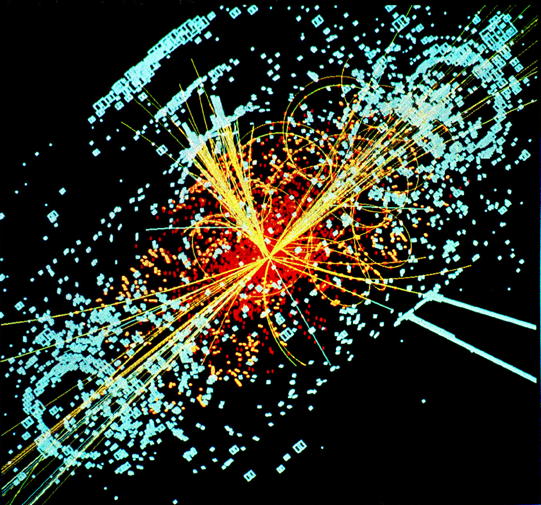
Credit: Lucas Taylor (CERN-EX-9710002)
License: © 1997-2026 CERN (License: CC-BY-SA-4.0)
Home | Bio | Music | Software | Teaching
Notes
for fixed media
by Reginald Bain
When Particles Collide (2026) is an electronic suite of five sonifications based on high-energy particle physics data. The music is encoded in software as algorithmic processes that generate the music from the data in real time. The data utilized in this work is from CERN's ATLAS detector, a particle detector at the Large Hadron Collider (LHC). CERN is the European Organization for Nuclear Research which is located on the border of France and Switzerland near Geneva, Switzerland, and the LHC is the world’s largest and most powerful particle accelerator.
Inspired by the work of CERN physicist Lily Asquith, whose sonifications of Higgs data were made available to the world via the website The Sounds of Science (CERN 2010; Asquith 2013), I create five sonification studies using Cycling 74's Max/MSP. Each study was composed on a different high-energy particle physics theme using a traditional approach to digital synthesis. Working in the realm of digital synthesis allowed me to compose sound at the micro level (Roads 2001). Each study was composed on different high-energy particle physics theme using a different traditional approach to digital synthesis. Working in the realm of digital synthesis allowed me to directly compose sound at the micro level (Roads 2001).
The first study, Cloud Chamber, is a brief two-voice canon that uses an additive synthesis approach to create the impression that two particles quickly circling around one another in a white hot gas. The second movement, Quantum noise, uses a subtractive synthesis approach to sculpt music from white noise. In the third study, String Theory, I used the Karplus-Strong physical model, which allowed me to perform on a virtual string that could be nearly any imaginable size. In the fourth study, Time Warp, I used granular synthesis to deconstruct an audio sample of a ticking clock into microscopic sound grains that are projected at various pitch and time scales to suggest the warping of time. The fifth and final movement, Radiant Energy, a brief movement that mirros the mirrors the first, uses Frequency modulation to create the sonic impression of pure energy.
| I. | Cloud Chamber |
0:51 |
| II. | Quantum Noise |
3:11
|
| III. | String Theory |
2:16 |
| IV. | Time Warp |
3:08 |
| V. |
Radiant Energy |
0:53 |
| D U R A T I O N: | 10:09 |
|
CERN, ATLAS Open Data – https://opendata.atlas.cern
CERN, ATLAS Experiment @ CERN – https://atlas.cern
The Detector | The Physics | | The Collaboration | What is CERN?
CERN, The Large Hadron Collider – https://home.cern/science/accelerators/large-hadron-collider
TIMESTORM FILMS, A timelapse visit of CERN, LHC and the ATLAS Experiment {YouTube} (Malin 2022)
Asquith, Lily. 2013. "Listening to data from the Large Hadron Collider." TEDxZurich Talk (December 9, 2013). Available online at: <https://youtu.be/iQiPytKHEwY?si=A9iB0DxoW4Bq3x6G>.
ATLAS Collaboration, et al. 2008. "The ATLAS Experiment at the CERN Large Hadron Collider." Journal of Instrumentation 3 (August 2008). DOI 10.1088/1748-0221/3/08/S08003.
CERN. 2010. "It Sounds Good!." CERN Bulletin (February 6, 2010). Available online at: <https://repository.cern/records/yncme-kp883>.
Hermann, Thomas, Andy Hunt, and John G. Neuhoff, eds. 2010. The Sonification Handbook. Berlin: Logos Verlag. {sonification.de}
Malin, Christoph. 2022. A timelapse visit of CERN, LHC and the ATLAS Experiment (2022). Film by Christoph Malin with music by Sid Acharya. Timestorm Films. {YouTube; ATLAS Experiment: YouTube Channel}
Ghosh, Pallab. 2010. "God particle signal is simulated as sound." BBC News (June 23, 2010). Available online at: <https://www.bbc.co.uk/news/10385675>.
Roads, Curtis. 2001. Microsound. Cambridge, MA: MIT Press. {GB}
This project was funded by a University of South Carolina Provost's Creative and Performing Arts Grant titled Music, Physics and Sonification. The data used in this work is from CERN's ATLAS Experiment (ATLAS 2008), which is available under a Creative Commons CC0 license at the CERN Open Data portal. Special thanks to physicists Milind Purohit and Reggie Bain of the University of South Carolina's High Energy Physics Group for their assistance with this project.
Updated: March 3, 2026