Home | Bio | Music | Software | Teaching

Notes

Double Helix

for fixed media

by Reginald Bain


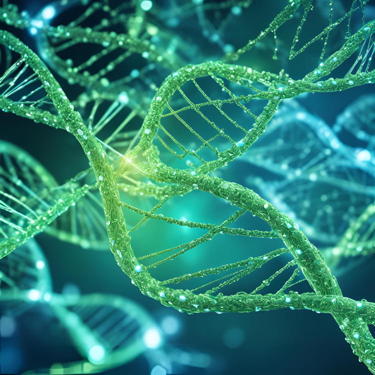
DNA image;
        Credit:Pixabay.com Double Helix (2019) is a data-driven electronic composition that utilizes genetic data as its source material. Built from the very fabric of life, here, genetic code becomes music.

Genetic data and musical data may both be viewed as a sequence. This creates a common ground where two usually distinct domains may meet. In this work, composer and machine collaborate in the  exploration of a seemingly infinite space of musical possibilities. Using Ableton Live and Cycling '74's Max, a graphical music programing environment, a DNA sequence and corresponding amino acid sequence are strategically mapped in real time to changing musical parameters including pitch, intensity, duration, timbre, and spatialization.

In the pre-compositional phase of the work's creation, the genetic data was freely mapped to musical parameters in myriad ways until aesthetically viable mapping strategies were discovered. Algorithms were designed to implement particular musical processes. The algorithms were repeatedly executed until desirable motifs emerged. The composer-programmer then worked to refine the mapping – in order to shape the musical  surface, controlling both macro and micro-level details of the data-driven music's structure.

Inspired by the music of Steve Reich (b. 1936) and other early American minimalist composers who experimented with technology, the composer adopts a process-oriented approach. The composer also invokes broader musico-genetic themes including the exceptionally beautiful metaphorical-mathematical bridge connecting the double-helix model of DNA (Watson and Crick 1953) with the helical model of pitch space (Shepard 1982).

The genetic data used in this composition is from the human gene CHD8 (chromodomain helicase DNA binding protein 8) which has been identified as a leading candidate gene for autism risk. The data was obtained from the National Center for Biotechnology Information (NCBI).


I. Major Groove 6:15
II. Biological Clocks
5:19
III. Seed 3:36
IV. Minor Groove 3:15
D U R A T I O N: 18:25

The world premiere of Reginald Bain's Double Helix took place on April 8, 2019, at the University of South Carolina's School of Music Recital Hall.


ICAD 2021 Sonification Concert

The third movement "Seed" was performed at the 2021 International Conference on Auditory Display (ICAD) Sonification Concert on June 26, 2021. The Sonification Concert program is available online at: https://icad2021.icad.org/program/. The accompanying paper (Bain 2021) is available in the conference proceedings. A recording of the virtual performance is available on YouTube.
ICAD 2021 Sonification Concert
June 26, 2021

 
Duration: 3:36


Links

Ableton Live, https://www.ableton.com

Cyling '74, Max, https://cycling74.com

NCBI, CHD8 chromodomain helicase DNA binding protein 8, Homo sapiens (human), NP_065971.2 https://www.ncbi.nlm.nih.gov/gene/57680

References

Bain, Reginald. 2021. "Seed," from Double Helix." Proceedings of the 26th International Conference of Auditory Display (ICAD 2021): 288-291. {SMARTech}

Shepard, Roger N. 1982. "Geometrical Approximations to the Structure of Musical Pitch." Psychological Review 89/4 (July 1982): 305–333. {APA PsycNET}

Watson, J. D. and Crick, F. H. C. 1953. "A Structure for Deoxyribose Nucleic Acid." Nature 171 (April 25, 1953): 737–738.


Acknowledgements

This composition was created for the Mutational Music Project, the broader impact component of the National Science Foundation (NSF) grant project Mutational variance of the transcriptome and the origins of phenotypic plasticity (NSF award #1556645). Jeff Dudycha was the principal investigator and Reginald Bain was the other senior person on the grant.
NSF logo


Updated: February 25, 2026